



















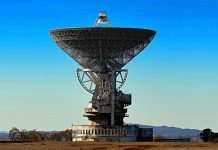





The First Satellites Back
The Ten Days — Story Two
The Sky Was Still Empty
Thirty-one days after the solar event ended, the first replacement satellite was scheduled to launch.
The announcement came from a government press room, where a spokesman stood before a screen showing a clean blue Earth and a small spacecraft turning slowly above it. The image was an artist’s rendering. The satellite did not yet exist in orbit, and the picture showed a world more orderly than the one below it.
The spokesman called the launch a milestone in humanity’s recovery.
Reporters asked what the satellite would restore.
He said it would demonstrate that the country could return to space.
They asked whether it would restore navigation, weather forecasting, communications, or emergency services.
He said those questions would be addressed in due course.
By that afternoon, the announcement had been repeated across the surviving news networks. The public heard that the first satellite was coming back. Many people assumed the return of the satellites had begun.
In a technical briefing later that evening, engineers offered a less reassuring description. The spacecraft was a communications satellite, but it would provide only a fraction of the coverage that had existed before the catastrophe. It could not replace navigation systems, weather satellites, scientific observatories, military surveillance platforms, and the thousands of other spacecraft that had been lost.
It could not do everything.
It could not even do most things.
But it could do something, and after a month of uncertainty, something had become a powerful word.
Across the world, governments were beginning to understand that the loss of satellites was not a problem that could be solved with a single launch, a single budget, or a single international agreement. The factories had not all vanished. Engineers still knew how to build spacecraft. Launch sites remained standing. Ground stations, fiber-optic networks, power plants, ports, and laboratories continued to function, though some had been damaged and others were operating under severe strain.
The knowledge to rebuild still existed.
What no longer existed was the system those capabilities had supported.
The old sky had been crowded with machines owned by governments, commercial companies, universities, and international partnerships. They had provided services that were often invisible to the people using them. Their disappearance had revealed how much depended on them—and how few replacements could be put into orbit quickly.
The first satellite would be a beginning.
The question was whose beginning it would be.
The List
The recovery committee met in a government building whose backup generators had become a permanent feature of daily life. Some offices still had unreliable power. Communications with distant agencies depended on a mixture of terrestrial networks, restored radio links, couriers, and scheduled calls.
The committee’s assignment appeared straightforward: decide which satellite services should receive priority.
The list was not straightforward.
Weather agencies wanted new observation satellites. Without them, forecasting had become more difficult, especially over oceans and remote regions. Ground-based radar, weather balloons, aircraft observations, and existing instruments still supplied valuable information, but the global picture was incomplete. Forecasts remained possible. Some warnings were less certain, and some events were harder to track.
Emergency-management officials wanted communications capacity that could reach places where terrestrial infrastructure had been damaged or where disasters might isolate communities.
Agricultural agencies wanted better observations of crops, soil moisture, and changing conditions. Farmers had not stopped planting simply because the satellites had disappeared, but planning across large regions had become more difficult.
Shipping companies wanted improved tracking. Airlines wanted navigation and weather services restored. Scientists wanted new instruments. Telecommunications operators wanted backup capacity for remote locations.
The military wanted secure communications, surveillance, missile-warning capabilities, and reliable navigation.
Every request had a reasonable argument behind it. Every delay had consequences.
The committee’s chair asked the members to rank their priorities.
The weather director argued that better forecasts could protect millions of people. The emergency coordinator pointed out that disasters would not wait for the space industry to catch up. The military representative said that a nation unable to monitor threats could not responsibly promise to protect its citizens.
The finance official asked which proposals could be delivered first, at what cost, and with what equipment.
That question narrowed the discussion.
The most sophisticated satellites could not simply be ordered from a catalogue. Specialized components had to be manufactured and tested. Some production lines had been interrupted by power failures, missing parts, or competing orders. Launch vehicles required their own preparation, and the facilities needed to handle them could not support unlimited launches.
A satellite completed on the ground was not yet a service. It had to be launched, placed into the correct orbit, checked out, connected to ground systems, and integrated into the networks that would use its data.
Even then, a single spacecraft could cover only a limited portion of the need.
The committee produced a priority list. It was a compromise, which meant no one was satisfied.
The military received the first protected allocation. Emergency communications and selected weather capabilities followed. Civilian navigation and commercial services were scheduled for later phases.
The chair called it a practical decision.
Outside the building, the announcement was described as a victory for national security.
The weather director read the list twice and began preparing a separate appeal.
A Launch Is Not a Recovery
The first replacement satellite reached orbit without incident.
For a few minutes, the control room watched the spacecraft’s signals appear on the screens. Engineers confirmed that its power system was operating, that it had established contact, and that its principal systems were responding. The launch team applauded. Some people cried.
The public announcement came shortly afterward.
The satellite was alive.
The service it had been designed to provide was not yet fully available.
Several days of testing remained. Ground stations had to verify the spacecraft’s performance, operators had to establish dependable procedures, and users needed compatible equipment and access arrangements. The satellite’s coverage was limited, and it had not been built to replace the full range of systems that had vanished.
Still, it mattered. It demonstrated that launch operations could resume and that the industrial chain required to put a satellite into orbit could work again.
The launch also exposed a harder problem.
There were more urgent requests than available launch opportunities. The first spacecraft had taken priority because its program was already far enough along to reach the launch pad. Other satellites were still being assembled, redesigned, or tested. Some needed components that could not be obtained quickly. Others were ready but had no confirmed launch date.
The world had not run out of engineers.
It had run into limits on manufacturing, testing, launch capacity, and time.
The space industry began working through a queue that had no accepted order. Commercial operators offered to accelerate production if governments guaranteed contracts. Governments wanted control over the systems they considered essential to national security. Smaller countries asked whether international agreements would provide them access to the new capacity or leave them waiting behind the larger powers.
A launch schedule became a political document.
Each slot could restore a useful service. Each decision to reserve one for a military spacecraft meant another service would wait. Each agreement to share capacity raised questions about who would operate the spacecraft, who could use its data, and who would have the authority to restrict access during a crisis.
The physical task was rebuilding satellites.
The political task was deciding who the rebuilt sky would belong to.
The Military Reservation
The military’s first replacement program was not publicly described in detail. Officials said only that it would restore essential capabilities.
That was enough to provoke criticism.
Civilian agencies wanted to know why military spacecraft received protected launch slots while weather and emergency systems remained incomplete. Military officials replied that some capabilities could not be discussed openly. They argued that surveillance and secure communications were not luxuries to be postponed until everyone else had been served.
The argument was not entirely about secrecy. Military systems often had requirements that civilian satellites did not: protected communications, resistance to interference, rapid tasking, and the ability to operate during a conflict. Those requirements could make a spacecraft more complex and expensive.
But the military also had political advantages. It could make its case in terms of national survival, and its plans were often protected from public scrutiny. Civilian agencies had to explain the cost of a delayed weather satellite in terms that competed with an unseen threat.
The dispute reached the cabinet.
One minister warned that the country could not rebuild everything at once. Another argued that the public would not accept a recovery program that restored military capabilities before services used by farmers, pilots, rescue teams, and ordinary businesses.
The defense minister replied that military readiness was one of the conditions that allowed civilian recovery to continue.
No one could prove that the other side was wrong.
The final decision kept the military’s protected allocation in place but required a public accounting of civilian restoration targets. The arrangement satisfied neither side. It also created a precedent: future satellite launches would be judged not only by technical readiness but by the political consequences of the services they restored.
Other governments watched closely.
Some announced similar priorities. Others publicly promised to put civilian systems first. A few did both, describing their military launches as necessary safeguards while presenting civilian projects as the visible face of recovery.
The language changed from country to country.
The underlying calculation did not.
No government wanted to be the first to depend on another country’s satellites for its security.
The Agreement
Before the catastrophe, several nations had shared data, launch services, tracking facilities, and elements of their satellite infrastructure. Those arrangements had never eliminated competition, but they had made some services cheaper and more reliable.
Now, with replacement capacity scarce, the old agreements were under pressure.
A group of countries proposed a shared recovery network. Participating governments would contribute funding, launch capacity, equipment, or technical personnel. The first systems would provide selected weather observations, emergency communications, and other services to all participants under common rules.
The proposal was practical. No single country could restore every lost service quickly, and cooperation could reduce duplication.
It was also threatening.
Countries that contributed the most money wanted a greater voice in scheduling and operations. Countries with launch facilities wanted guarantees that their own programs would not be pushed aside. Smaller nations wanted assurance that shared access would not disappear the moment a major participant declared a national emergency.
The most difficult question concerned control.
If a satellite carried data useful to every member, could one government restrict that data during a military crisis? Could a participating country use shared infrastructure to support operations that another member opposed? Who would decide when an emergency justified an exception?
Negotiators drafted safeguards, then discovered that each safeguard required another definition, another review, and another authority empowered to make a decision.
The meetings continued while the launch queue grew.
A provisional agreement was finally announced. The participating nations would pool selected resources, share specified data, and reserve a portion of future capacity for common civilian purposes. National security systems would remain outside the arrangement, and the agreement allowed temporary restrictions under defined emergency conditions.
The announcement was hailed as a breakthrough.
Within days, the first dispute emerged.
One participant wanted access to a service that another considered too sensitive to share. The second government argued that the agreement did not require it to provide the information. The first argued that withholding it violated the spirit, if not the letter, of the deal.
Both governments released statements accusing the other of undermining cooperation.
The shared network had not yet launched its first joint satellite, and already the argument over who controlled it had begun.
The Weather Gap
The consequences of the delay were not always dramatic enough to make headlines.
A forecast arrived with less confidence than it once had. A shipping company changed a route. An agricultural agency revised its estimates. A regional emergency office asked for additional aircraft observations before issuing a warning.
Weather forecasting had not stopped. Meteorologists still had surface observations, radar, balloons, aircraft reports, numerical models, and the expertise to use them. But the missing satellite observations left gaps, particularly over oceans and regions with few ground-based instruments.
Those gaps mattered because forecasts were built from many kinds of evidence. No single instrument supplied the whole picture. Satellite observations had helped fill in the spaces between stations and provide repeated views of large areas. Replacing them meant rebuilding not only spacecraft but also the information flow that connected observations to forecasts and decisions.
The first replacement weather instruments would improve the picture, but not all at once. Different orbits served different purposes. A spacecraft designed for one kind of observation could not automatically replace another. Ground systems had to be ready to receive and process the data, and agencies needed staff and procedures to put the information to use.
Officials began speaking of restoration percentages.
The figures were useful for reports and almost meaningless to the public. A service might be partly restored in one region and unavailable in another. A satellite could be operating while the larger system remained incomplete. A network could function under normal conditions but lack the redundancy that had once protected it against failures.
Recovery was not a switch being turned back on.
It was a collection of uneven improvements, each dependent on other improvements that had yet to arrive.
The same was true of navigation. Many vehicles could still use terrestrial navigation methods, inertial systems, maps, and local infrastructure. Some transport systems had independent backups. But satellite navigation had been woven into countless civilian and commercial applications, and rebuilding the space segment alone would not restore every capability. Receivers, timing systems, software, and operating procedures also mattered.
The public wanted a date when things would return to normal.
The experts increasingly avoided the word normal.
The old system had been built over decades. The replacement system would be built under pressure, with different priorities and a new awareness of how much could be lost at once.
Even if the new satellites were better in some ways, they would not arrive together.
The Countries Left Waiting
The first wave of launches favored countries with established space industries, functioning launch facilities, access to specialized components, and the financial resources to fund large programs.
That outcome was predictable. It was also dangerous.
Countries without launch capability depended on foreign providers. Those providers had their own military commitments, commercial contracts, and domestic political pressures. A government might promise support to an ally and then discover that its available launch capacity had already been reserved for another purpose.
Some countries negotiated partnerships. They offered money, ground stations, scientific expertise, or access to facilities in exchange for a place in a shared program. Others pooled resources with neighboring states. For smaller economies, cooperation was often the only realistic path to restoring capabilities that would have been too expensive to rebuild independently.
But dependence had a price.
A country that relied on another nation’s satellite services had to consider what would happen if relations deteriorated. Would access continue during a dispute? Could the provider change terms? Would data be delayed, filtered, or withheld? Could a government trust a service whose operation it did not control?
These questions had existed before the catastrophe. The loss of the old systems made them immediate.
A few governments announced that they would develop sovereign satellite capabilities, even if doing so cost more and took longer than joining an international network. Their leaders argued that independence was worth the expense.
Their critics asked whether the money would be better spent on power infrastructure, communications networks, hospitals, or other systems that could deliver benefits sooner.
The debate was not simply between cooperation and isolation. A country could cooperate in one area while insisting on independence in another. It could share weather data while keeping military communications separate. It could buy commercial services while building a limited national capability for emergencies.
The challenge was deciding which dependencies were acceptable.
There was no universal answer. Geography, wealth, industrial capacity, security concerns, and political relationships all mattered. A policy that made sense for a large spacefaring nation might be impossible for a small country. A partnership that worked during a period of trust might become fragile during a regional conflict.
The new satellite order was taking shape before the first generation of replacement systems was complete.
The Breach
The first major breach of the shared recovery agreement came over a launch reservation.
The agreement had set aside a portion of future capacity for common civilian services. A participating government later requested that one of those slots be reassigned to a national security spacecraft. Its officials said a newly identified threat made the change necessary. They offered to restore the civilian slot later, when another launch became available.
The other participants objected.
The disputed launch could carry a spacecraft intended to improve emergency communications and weather coverage across several countries. Delaying it would prolong a known gap. The proposed military satellite, meanwhile, served a purpose that the requesting government described only in general terms.
The requesting government argued that it could not ignore a threat merely because a shared schedule existed.
The others argued that the agreement was meaningless if a powerful participant could set it aside whenever its own priorities changed.
Emergency consultations began. Officials reviewed the wording of the agreement, compared launch schedules, and searched for a compromise. The government requesting the change offered additional funding. Another participant suggested using a different launch vehicle, but the alternative required technical adjustments and would not be ready in time.
The deadline approached.
Finally, the launch reservation was reassigned.
The government that had lost the slot called the decision a breach of trust. The government that received it called the decision necessary. The other participants issued a statement expressing concern but stopped short of suspending the agreement.
The shared program survived.
Its credibility did not emerge untouched.
Every future promise now carried an additional question: would the schedule still hold when a national interest conflicted with a collective one?
The breach did not prove that international cooperation was impossible. It proved that cooperation required more than signatures. It needed rules that governments would accept when the rules became inconvenient, and consequences when they did not.
Those were harder things to build than a satellite.
A Different Kind of Race
By the third month of recovery, governments had begun announcing plans for new satellite constellations. Commercial companies proposed systems that could be manufactured more quickly, launched in batches, and replaced more frequently. Research agencies worked on instruments that could provide several kinds of observations. Military planners sought systems designed to remain useful under hostile conditions.
Some proposals promised better resilience than the old infrastructure. Networks of smaller satellites could distribute capabilities across many spacecraft instead of concentrating them in a few expensive platforms. Terrestrial fiber, radio networks, local sensors, and independent timing systems could reduce reliance on space-based services where practical.
But no design eliminated every vulnerability.
Large satellites could provide capabilities that smaller systems could not easily duplicate. Constellations required many launches and continuous maintenance. Terrestrial networks depended on power, physical routes, and equipment that could fail. Independent backups cost money and needed to be tested before an emergency, not merely promised afterward.
The central question was no longer whether the world should rebuild its satellite infrastructure. It was how to rebuild without reproducing every weakness of the old system.
There were encouraging signs. Engineers redesigned components that had been difficult to replace. Agencies improved contingency plans. Some governments invested in ground-based observations and terrestrial communications, recognizing that resilience meant having alternatives rather than relying on a single technology.
There were also less encouraging signs.
National programs competed for the same skilled workers and specialized parts. Governments guarded technical information. Companies sought long-term contracts that would protect their investments, while public agencies worried about becoming dependent on a small number of private suppliers. Countries that had once shared services began to treat them as strategic assets.
The new race was not simply to put satellites into orbit first.
It was a race to decide who would own the infrastructure on which other nations might depend.
The catastrophe had shown that a global system could be indispensable without being equally controlled by everyone who used it. The rebuilding process offered a chance to change that arrangement—or to create a new version of it.
The outcome remained uncertain.
The First Satellites Back
Six months after the solar event, the sky was no longer entirely empty.
A limited number of replacement satellites had reached orbit. Some were providing useful communications capacity. Others were beginning to restore weather observations, scientific measurements, or selected government services. More spacecraft were being built, and launch operations were becoming more regular.
The improvements were real.
So were the gaps.
Navigation services remained incomplete. Weather agencies still worked with fewer observations than they had once possessed. Commercial networks were unevenly restored. Countries without strong space industries continued to negotiate for access, while wealthier nations built systems that reflected their own priorities.
The world was recovering, but it was not returning to its previous condition.
The first satellite had been a symbol of what could be done. The launches that followed were becoming a test of what governments were willing to share, what they intended to control, and how much they trusted one another.
In a meeting reviewing the next phase of reconstruction, an engineer presented two plans.
The first would restore selected services as quickly as possible by concentrating resources in the systems already closest to completion. It was cheaper in the short term and would produce visible results sooner.
The second would take longer. It would add backup capabilities, spread critical services across more systems, and reduce dependence on any single provider. It would require more money, more coordination, and agreements that were still being negotiated.
A finance official asked how much longer.
The engineer gave an estimate, then explained the uncertainties behind it.
A defense representative asked whether the second plan would leave the country exposed during the transition.
The engineer said that was possible.
A civilian agency director asked whether the first plan would leave the same vulnerabilities in place.
The engineer said that was possible, too.
The room fell quiet.
There was no technical answer that could remove the political choices. The first plan favored speed. The second favored resilience. Both carried risks, and neither could restore the entire system at once.
The committee postponed its decision until the following week.
Outside, a new satellite passed over a ground station, sending a brief stream of data toward an antenna. The station received it, checked it, and forwarded it to a team waiting to put it to use.
It was a small success, invisible to most of the world.
But it was not the old sky returning. It was the first part of a different one.
The catastrophe had destroyed the satellites, not the knowledge required to build them. It had damaged infrastructure and disrupted services, but it had not erased the factories, the engineers, the power stations, the roads, the ports, or the institutions that could support recovery.
The world could rebuild.
What remained uncertain was whether it would rebuild as a shared system or as a collection of competing systems, each designed to protect its own owner first.
The next generation of satellites would answer some questions. It would not answer that one.
For the first time in decades, the sky was being rebuilt from the ground up.
And the nations looking upward were already arguing over who would control it.
Author’s Note
The First Satellites Back is the second story in The Ten Days, a speculative-fiction series about the consequences of a catastrophic solar event that destroys the world’s satellite capabilities. The story explores the difficult transition from immediate crisis to long-term recovery, with particular attention to technological limits, national security, international cooperation, and the political choices that shape reconstruction.
The series does not assume that the loss of satellites automatically destroys civilization. It examines how a society with surviving knowledge and infrastructure can recover—and how competition among nations can make that recovery slower, more expensive, and less equitable.
Copyright Notice
This story is a work of speculative fiction. The characters, events, organizations, and situations portrayed are fictional or imagined for the purposes of this story. Any resemblance to actual persons, events, or organizations is coincidental.
No part of this publication may be reproduced, distributed, or transmitted in any form or by any means without prior written permission from the copyright holder, except for brief quotations used in reviews or other uses permitted by copyright law.