





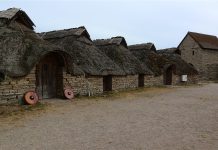

















Bissula — The Seven Villages
The summer after Bissula discovered the strange footprints in the forest, the seven villages began to change.
At first, the changes were small.
A hunter failed to return from the northern woods. A wagon carrying grain was found abandoned beside a forest road. A shepherd reported seeing strangers watching from a distant ridge. Then, one morning, a messenger arrived at Eichenwald carrying news that could no longer be ignored.
A village to the north had been attacked.
Bissula stood beside her father as the messenger described what had happened.
“They came before sunrise,” the man said. “There were perhaps thirty warriors. They took the livestock, the grain, and everything of value. Anyone who resisted was struck down.”
“Who were they?” Alaric asked.
The messenger hesitated.
“Men wearing the black wolf emblem.”
The longhouse became silent.
Everyone knew what that symbol meant.
Grimhild.
For generations, the seven villages had survived because the forest made them difficult to reach. Their people hunted beneath the ancient trees, cultivated small fields in the clearings, raised animals, and traded among themselves. They were not a kingdom. There was no single ruler.
There were seven villages. Seven chiefs. Seven councils.
And seven different ideas about how the people should live.
Eichenwald, the largest village, stood among enormous oak trees. It was known for its hunters and skilled woodworkers.
Ravensmark lay farther north, where dark forests covered the hills. Its people were excellent scouts and hunters.
Flussheim was built beside a broad river and was famous for fishing, boats, and trade.
Steinwald stood among rocky hills where hunters gathered game and stoneworkers shaped tools and weapons.
Waldheim occupied fertile land and produced much of the grain that fed the other villages.
Eberdorf was known for raising horses, cattle, and pigs.
The seventh village, Falkenruh, stood on a high ridge overlooking the valleys. Its people were watchful and independent, and its warriors were considered among the finest archers in the region.
The villages needed one another. Yet they rarely agreed. Bissula understood this better than anyone.
She had traveled among all seven villages with her father and had seen their differences firsthand. The people of Flussheim thought the farmers of Waldheim were too demanding. The horse breeders of Eberdorf believed the hunters of Ravensmark took too much land. The chiefs frequently argued over boundaries, trade, and hunting rights.
For years, those disagreements had seemed harmless.
Now they were becoming dangerous.
Three days after the first attack, another messenger arrived.
This time the village of Ravensmark had been raided.
Then came news from Eberdorf.
Grimhild was moving south.
Bissula’s father called an emergency council.
“We need the seven chiefs together,” Bissula said.
Alaric nodded.
“I agree.”
“Then send messengers.”
“They will come.”
“Will they?”
Her father looked at her.
Bissula continued.
“They have spent years arguing with one another. Some will think Grimhild’s attacks are someone else’s problem.”
Alaric sighed.
“You may be right.”
“Then let me go.”
“To the other villages?”
“Yes.”
“You are asking seven chiefs to listen to a young woman.”
“I am asking them to listen to someone who has seen what is happening.”
Her father studied her face.
Finally, he nodded.
“Then go.”
Bissula set out the following morning.
Her first destination was Waldheim.
The chief listened politely as she described the attacks but dismissed the danger.
“We have strong walls,” he said. “Grimhild will not waste his warriors attacking farmers.”
Bissula stared at him.
“He already has.”
The chief’s expression changed.
Her next journey took her to Eberdorf, where the chief was more interested in protecting his horses than discussing an alliance.
At Steinwald, the chief demanded to know what Eichenwald would contribute.
At Flussheim, the elders argued that the river gave them protection.
At Ravensmark, Bissula found people preparing for another attack.
Falkenruh was different.
Its chief, an elderly woman named Astrid, listened without interrupting.
When Bissula finished, Astrid asked only one question.
“How many warriors does Grimhild have?”
“We don’t know.”
“And how many do the seven villages have?”
Bissula hesitated.
“Together? Perhaps two hundred.”
Astrid nodded.
“And separately?”
Bissula understood immediately.
“That is the problem.”
Astrid smiled.
“You have your father’s courage.”
“I need more than courage.”
“Yes,” Astrid replied. “You need the chiefs to understand that their walls will not protect them forever.”
Bissula returned to Eichenwald after several weeks.
She had not convinced all seven chiefs.
But she had accomplished something important.
She had made them think.
Then, before she could report everything to her father, a rider came galloping into the village.
His horse was exhausted.
His clothes were torn.
“Grimhild’s army has crossed the northern ridge,” he gasped.
The village fell silent.
“How many?” Alaric asked.
The rider shook his head.
“Too many to count.”
Bissula looked toward the forest.
She realized the time for arguments was ending.
That evening, she stood before the warriors of Eichenwald.
“We have waited for someone else to solve this problem,” she said. “We waited for the chiefs. We waited for the other villages. We waited for Grimhild to stop.”
She raised her sword.
“He will not stop.”
The warriors gathered closer.
“Tomorrow,” Bissula continued, “we ride to the other villages. Not as enemies. Not as rivals. We go as one people.”
A young warrior shouted, “And if they refuse?”
Bissula looked toward the northern hills.
“Then we convince them.”
“And if they still refuse?”
Her green eyes hardened.
“Then we defend them anyway.”
The warriors cheered.
Far away, beyond the hills, wolves howled in the darkness.
Grimhild was coming.
And for the first time, the seven villages were beginning to understand that their greatest enemy was not simply the army approaching from the north.
It was the division among themselves.
Bissula intended to change that.