
























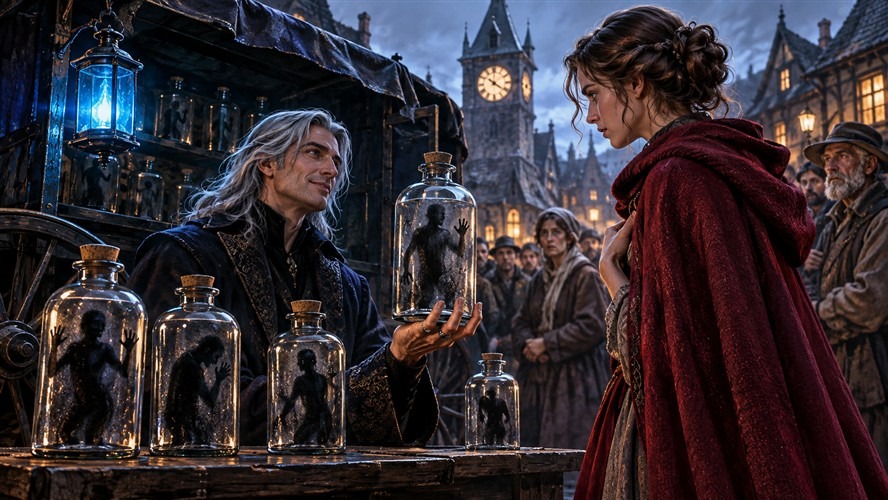
The Shadow Seller
A Dark Fantasy
I. The Stranger Arrives
The merchant arrived in the village of Bellweather on a Thursday, just before sunset.
Nobody saw him enter.
One moment the market square was empty except for the usual stalls, scattered straw, and a few chickens scratching in the dirt. The next, a small black wagon stood beneath the old clock tower.
It was an unusual wagon. Its wooden sides were painted black, its wheels made no sound against the cobblestones, and its single lantern burned with a pale blue flame. There was no horse attached to it, nor any sign of how it had reached the square. Its paint was so dark that it seemed to absorb the fading light rather than reflect it.
The man standing beside it was equally unusual.
He was tall and thin, dressed in a long dark coat that seemed too fine for a traveling merchant. His hair was silver, though his face was neither young nor old. His eyes were a curious gray, like the sky before a storm. He wore polished black boots and carried a small leather case in one hand.
A small sign hung from the wagon.
THE SHADOW SELLER
Beneath it, in smaller letters:
Leave behind what troubles you.
People gathered, naturally enough. Bellweather was a village where news traveled faster than the wind, and a stranger with an unusual business was certain to attract attention.
The baker came out of his shop, wiping flour from his hands. The blacksmith left his forge. Several women stopped their shopping, and a handful of children edged closer until their mothers called them back.
The merchant smiled. “Good evening,” he said. “I have something to offer that you may find useful.”
“What are you selling?” asked the baker.
The merchant gestured toward the ground. “Nothing you can eat. Nothing you can wear. I buy shadows.”
There was laughter.
“Shadows?” someone repeated.
“Indeed.”
The merchant lifted his hand. His own shadow stretched across the cobblestones, although the sun had already disappeared behind the western hills. It was unusually long and thin, reaching almost to the feet of the people gathered around him.
“Every person carries one,” he explained. “Some are heavy. Some are troublesome. Some contain memories their owners would rather forget. Others are burdened by fears, regrets, jealousies, and disappointments. I can take them away.”
“And what do you pay?” asked the baker.
“That depends upon the shadow.”
The merchant opened a small leather purse and displayed several gold coins. They caught the light from his blue lantern. “Enough to make the bargain worthwhile.”
The laughter gradually stopped.
A woman near the front stepped forward. “You’re saying you can take away sadness?”
“I can take away the part of you that carries it.”
“Would I still remember what happened?”
“Of course. I am not a thief of memories. You will remember the events of your life. You simply will no longer suffer from them.”
“And the price?”
“That depends upon the weight of your shadow.”
The woman looked down at the dark shape beneath her feet. For a moment, nobody spoke.
The merchant folded his hands.
“Consider what you might do with a little less sorrow. How much easier your days might become. How much lighter your heart.”
A man laughed nervously. “And what happens to the shadows?”
The merchant smiled. “That is my business.”
He closed his purse. “Think about it. I shall be here tomorrow.”
That evening, the people of Bellweather talked about little else.
Some called the stranger a fraud. Others thought him a magician. A few insisted that the entire affair was a trick designed to separate foolish villagers from their money.
But several people lay awake wondering what it might be like to wake the next morning without the particular misery they had carried for years.
The merchant’s lantern continued to burn beneath the clock tower long after the square had emptied.
II. The First Bargain
The first person to approach was Thomas Miller, a farmer whose wife had died two winters earlier. Thomas had once been a cheerful man. He had loved his wife, Margaret, and the two had worked their small farm together for more than thirty years. They had no children, but their house had always been full of friends, neighbors, and the ordinary business of a happy marriage.
Then Margaret became ill.
The illness lasted eleven months. Thomas spent most of that time beside her bed, holding her hand and listening to her breathing become weaker. When she died, the house became unbearably quiet.
He continued to work his land, but the pleasure had gone out of it. He rarely visited his neighbors. He had stopped attending the village gatherings and had not spoken more than necessary to anyone.
His friends had tried to help, but he had little patience for their sympathy.
On the morning after the merchant arrived, Thomas stood in the market square for nearly an hour before approaching the wagon. “What would you take from me?” he asked.
The merchant studied him. “Your grief.”
Thomas looked down. “Can you really do that?”
“I can remove the shadow in which it lives. You will remember your wife, of course. You will remember her face, her voice, and the years you shared. But the sorrow will no longer follow you.”
Thomas swallowed. “I don’t want to forget Margaret.”
“You will not.”
“She was my wife. I loved her.”
“And you will continue to know that. But you need not suffer every time you remember her.”
Thomas stood quietly. “Sometimes I hear her voice,” he said. “I know she’s gone, but I still turn around expecting to see her. I can’t sit at the table without thinking about the empty chair. I can’t walk past the orchard without remembering how we planted the trees together.”
The merchant listened with the expression of a man who had heard such things many times. “Then you understand what I am offering.”
Thomas hesitated. “What is the price?”
“Three gold sovereigns.”
It was more money than Thomas had seen in his hand for months. He looked at the coins, then at the merchant.
“Will I be happy?”
“You will be free of grief. What you do with that freedom is up to you.”
Thomas finally agreed.
The merchant took a small silver instrument from his coat. It resembled a pair of scissors, although its blades were impossibly thin. He knelt and carefully cut along the outline of Thomas’s shadow.
There was no pain.
The shadow detached itself from the farmer’s feet and rose slowly from the ground. It hung in the air like a dark piece of cloth, its edges moving as though stirred by a wind nobody else could feel.
For a brief moment, Thomas thought he heard a woman calling his name.
Then the merchant folded the shadow neatly and placed it inside a glass container. He sealed the lid.
Thomas blinked. The sadness was gone.
He looked around the square, then at the three gold coins in his hand. A smile spread across his face. “Well,” he said. “That was easier than I expected.” He walked home whistling.
By the following morning, Thomas was cheerful. He greeted his neighbors, joked with the baker, and sang while working in his fields. When someone mentioned Margaret, he smiled politely and said she had been a good woman.
But he did not visit her grave.
When his neighbor asked why, Thomas shrugged. “What’s the point? She’s gone, isn’t she?”
The neighbor found the answer unsettling, but Thomas seemed perfectly content.
Others soon followed. A woman named Elspeth sold the shadow of her jealousy. Her husband had been unfaithful years earlier, and although they had remained married, she had never entirely trusted him again. The merchant promised to remove the suspicion that poisoned her thoughts.
A shopkeeper sold his fear of failure. He had always wanted to expand his business but was terrified of losing what little he owned. The merchant took that fear and paid him five sovereigns.
A young man named Peter sold the shadow of an unhappy childhood. His father had been a cruel and violent man, and Peter had spent years trying to forget the things that happened in the family home.
He left the wagon smiling. “I feel as though I’ve been given my life back,” he told his friends.
Within a week, the merchant had more business than he could manage. People came from neighboring farms and villages. Some sold their anger, others their envy, shame, guilt, loneliness, or regret. The merchant never appeared hurried. He listened patiently, named a price, and performed his strange operation with the silver scissors.
Each customer left lighter, happier, and richer. The villagers began to regard him as something of a miracle worker.
Only a few noticed that the people who sold their shadows seemed to have lost more than their troubles.
III. Liora
Liora was twenty-seven years old and worked as a seamstress. She was neither wealthy nor particularly poor. She lived alone in a small house near the river and earned enough to support herself. Her work was good, and she had a steady collection of customers who appreciated her skill and her refusal to charge more than a job was worth.
She was also curious, independent, and difficult to persuade. Liora had learned early that a woman who depended too heavily on the good opinion of others could spend her entire life trying to please people who would never be satisfied.
Her mother had died when she was sixteen. Her father had been a quiet man who believed that daughters should marry, raise children, and leave difficult decisions to their husbands. Liora had disagreed. Their arguments had grown sharper as she became older, until one day she had packed her belongings and left. They had not spoken for nearly three years.
Eventually, they had made their peace, but neither had ever entirely forgotten the hurt.
Liora still remembered their arguments. She sometimes regretted the things she had said, and sometimes believed she had not said nearly enough. She carried affection, anger, pride, and regret in roughly equal measure.
She had watched the merchant’s business with growing suspicion. At first, she thought it was a trick. Then she began noticing something strange about the people who had sold their shadows.
They were happy, certainly. But they were also changing.
Thomas Miller no longer visited his wife’s grave. When an old friend spoke of Margaret, Thomas seemed impatient, as though the subject had little importance.
Elspeth no longer cared whether her husband was faithful. When he began openly flirting with a young widow who lived nearby, Elspeth merely laughed.
Peter, the young man who had sold his unhappy childhood, could no longer remember the name of the friend who had grown up beside him. He knew that he had once had a close friend, but the memories were vague and strangely empty.
The shopkeeper who had sold his fear of failure began taking foolish risks with his money. He seemed unable to recognize danger.
They were content, but something about them seemed diminished.
One afternoon Liora approached the merchant. He was sitting beside his wagon, polishing the silver scissors with a small cloth. “How much would you pay for my shadow?”
The merchant examined her carefully. “That depends on what it contains.”
“And how do you know?”
“I have been doing this a very long time.”
“That wasn’t my question.”
For the first time, the merchant looked amused.
“You are a difficult young woman.”
“I’ve been told.”
He rose and walked around her, studying the dark shape at her feet.
“Yours is unusually interesting.”
“Why?”
“It contains anger, regret, ambition, affection, disappointment, and a considerable amount of pride.”
“Sounds like a fairly ordinary person.”
“Perhaps. But yours is not an ordinary shadow.”
Liora folded her arms.
“What would you remove?”
“Whatever troubles you most.”
“And what would I become afterward?”
The merchant smiled. “Happy.”
“That sounds rather dull.”
“People who come to me rarely complain of boredom.”
“Perhaps they have forgotten how.”
The merchant’s expression changed slightly. “You have a sharp tongue.”
“Better than a dull mind.”
He laughed, but the sound was not particularly warm. “Your shadow would be worth a considerable sum. I could make you comfortable for the rest of your life.”
“I already make a living.”
“Then you could enjoy it without worry.”
Liora looked down at her shadow.
“Would I still be angry when someone cheated me?”
“Why would you wish to be angry?”
“Would I still care if someone I loved died?”
“You would remember them.”
“Would I still be afraid of losing someone?”
“Not in the way you are now.”
“And would I still love?”
The merchant paused. “Of course.”
“Would I still know when someone was lying to me?”
“That would depend on your judgment.”
“Which might be rather poor if you remove my suspicion.”
The merchant’s smile disappeared.
Liora turned away.
“Keep your money.”
He watched her go. He did not look amused anymore.
IV. The Storeroom
Liora began watching the wagon more closely. The merchant conducted his business during daylight, but each evening he disappeared behind a narrow door at the rear of the wagon. Nobody was permitted inside.
The door was always locked.
One night, shortly after midnight, Liora returned to the market square. The village was quiet. A light rain had begun to fall, and the cobblestones shone beneath the pale blue lantern. The wagon stood beneath the clock tower as it had every night since the merchant arrived.
She approached cautiously. The door at the rear was slightly open. She waited, listening.
There was no sound from inside. Liora pushed the door. It swung inward without a creak.
Beyond it was a narrow passage leading to a room much larger than the wagon could possibly contain. The walls were lined with dark wood, and a cold blue light filled the space.
Shelves covered every wall. Upon them stood hundreds of glass containers, each holding a folded shadow.
Some were small. Others were enormous. Some seemed almost transparent, while others were so dark that they appeared to swallow the light around them.
And they were moving.
Liora approached the nearest shelf. A shadow inside one container pressed itself against the glass. She heard a voice.
“Please.”
She stepped backward.
Another voice came from a container nearby.
“Let me out.”
Then another.
“Where am I?”
Liora stared.
The shadows were alive. They twisted and stretched inside their containers, reaching toward her with shapes that resembled hands. Some were silent, while others whispered continuously.
She moved farther into the room. On a shelf near the back she recognized Thomas Miller’s shadow. It was bent over, its hands covering its face.
She recognized Elspeth’s shadow, too. It was pacing furiously inside its glass prison, moving from one side of the container to the other.
Peter’s shadow was curled into a small, frightened shape.
The shadows remembered everything. They remembered grief, jealousy, fear, love, and anger. They remembered the people who had abandoned them. And they wanted to go home.
Liora placed her hand against Thomas’s container.
The shadow immediately pressed toward her. “Thomas,” she whispered.
The shadow moved. “He doesn’t remember,” it said.
Liora pulled her hand away. “Doesn’t remember what?”
“Me.”
The shadow stretched against the glass. “He remembers her. He remembers her face. But he doesn’t remember what it meant to love her. He doesn’t remember why he cried.”
Liora looked at the other containers. “Can you all hear me?”
A chorus of whispers answered.
“Yes.”
“Help us.”
“Please.”
“Let us out.”
She noticed something else.
At the base of each container was a small silver plate. Each bore a name and a brief inscription describing what had been taken.
THOMAS MILLER — GRIEF.
ELSPETH MILLER — JEALOUSY.
PETER HAWTHORNE — CHILDHOOD PAIN.
The plates were arranged like the labels on a merchant’s inventory.
Liora felt a chill. These were not merely possessions. They were pieces of people, carefully catalogued and stored.
She reached toward a container holding a small, restless shadow. It pressed against the glass. “Who are you?”
The shadow did not answer immediately. Then it whispered, “I am the part that remembers.”
A sound came from the passage. Liora turned.
The merchant’s voice drifted through the darkness. “Curiosity is a dangerous habit.”
V. The Merchant’s Explanation
The merchant stood in the doorway. His expression was calm, but his eyes had hardened.
Liora turned to face him. “You told them you were removing their troubles.”
“I was.”
“You imprisoned them.”
“I preserved them.”
“They’re alive.”
“Of course.”
He walked between the shelves, running one pale finger along the glass containers.
“Do you imagine that happiness is possible without sacrifice? People come to me because they cannot bear the weight of their own lives. They ask for relief. I provide it. They accept the bargain willingly.”
“You take more than they understand.”
“That is not my concern.”
“Then what do you do with the shadows?”
The merchant stopped beside a tall cabinet.
“I keep them.”
“Why?”
“Because they are useful.”
He opened the cabinet. Inside were several empty containers, each fitted with a silver clasp.
“Every shadow contains a portion of its owner’s nature. Courage, desire, anger, affection, ambition. These things are difficult to manufacture. But they can be collected.”
Liora stared at him. “And what do you intend to do with them?”
The merchant’s smile returned. “Imagine a world without grief. Without jealousy. Without fear. Without the troublesome impulses that cause people to fight, question authority, or challenge their circumstances.”
“You want a world of obedient people.”
“I want a world of happy people.”
“Those aren’t necessarily the same thing.”
“Only because people have become accustomed to suffering. They mistake it for meaning.”
He closed the cabinet. “Consider your farmer. Thomas Miller spent two years unable to enjoy his own life. His grief consumed him. He came to me willingly. I gave him peace, and he gave me something of value in return.”
“You gave him money.”
“I gave him more than money.”
“You gave him a life in which he can remember his wife without loving her properly.”
The merchant looked at her. “Love is not grief.”
“No. But grief is sometimes the price of having loved.”
For the first time, the merchant seemed genuinely interested in her answer. “An attractive sentiment. But sentiment does not change the nature of suffering.”
“Neither does putting it in a jar.”
He smiled faintly. “You still believe that people are better for carrying their burdens.”
“I believe they should decide what to carry.”
“People are poor judges of what is good for them. They come to me because they are tired of making those decisions.”
“Then you make the decisions for them?”
“I offer a choice.”
“A choice they don’t understand.”
“Understanding is overrated. The results speak for themselves.”
Liora looked around the room. “And what happens when you have enough shadows?”
The merchant’s eyes moved toward the shelves. “Enough is a word with no useful meaning.”
He walked toward the far end of the room.
“One day, perhaps, there will be enough. Enough courage to make the timid brave. Enough ambition to give direction to the idle. Enough affection to make the loveless capable of attachment. Enough fearlessness to remove the obstacles that keep people from accepting the world as it should be.”
“Whose world?”
The merchant turned. “Mine, if you insist upon being difficult.”
Liora stared at him. There it was. The truth beneath all his pleasant promises. He did not want to make people happy. He wanted to make them manageable.
A world without grief might also be a world without loyalty. A world without jealousy might be a world without passion. A world without fear might be a world without caution. A world without anger might be a world in which injustice went unanswered.
And a world without ambition or dissatisfaction would never change.
The merchant was collecting the very things that made people difficult to control.
VI. The Bargain Reversed
Liora looked at the shelves. “How do I get them out?”
“You cannot.”
“Everything has a weakness.”
The merchant laughed softly.
“Perhaps. But you do not understand what you are dealing with.”
He approached her. “I will make you an offer. Your shadow is valuable. I will pay you more than anyone else in this village. You could live comfortably for the rest of your life. You could travel, buy a fine house, and never work another day.”
“And if I refuse?”
“Then you will continue carrying your burdens.”
Liora glanced toward the containers.
“That sounds like a threat.”
“It is a simple statement of fact.”
“You’re afraid of my shadow.”
The merchant stopped. “Afraid?”
“You’re offering me more than you offered anyone else. You want it badly.”
He studied her. “Your shadow contains an unusual mixture of qualities. You have known loss, but you have not surrendered to it. You have anger, but you can control it. You have ambition, but you do not worship wealth. You question what others accept.”
“That last quality seems to trouble you.”
“It is an inconvenience.”
“Then perhaps you should buy it.”
“I would gladly do so.”
Liora smiled.
“At least we’re being honest.”
She looked again at the glass containers.
She thought of Thomas Miller, who had forgotten the sorrow that had once been the measure of his love. She thought of Elspeth, who no longer cared whether her husband loved her. She thought of Peter, who had lost the memories that made him who he was.
They had all made their bargains willingly. But none had understood the full price. “You’re wrong about one thing,” she said.
“And what is that?”
“People don’t become better by removing everything that makes life difficult.”
The merchant’s expression darkened.
“Do not confuse suffering with virtue.”
“I don’t. But I know that removing suffering isn’t the same as making someone whole.”
She reached for the nearest container.
The merchant moved quickly, but Liora was quicker. She seized the glass vessel and threw it against the stone floor.
It shattered. The shadow inside rose like smoke. For a moment it hovered above the broken glass, uncertain and trembling. Then it shot through the room like a gust of wind.
A terrible sound filled the chamber. Every container began to tremble.
The merchant shouted. “Stop!”
But Liora had already seized another. She threw it.
Then another.
Glass broke against the stone. Shadows poured into the air. The room filled with darkness, not the darkness of night, but something alive and furious.
Some of the shadows rushed toward the passage. Others circled the shelves, searching for their way out. A few seemed to hesitate, as though they had forgotten how to move freely.
The merchant raised his silver scissors. “Enough!” He snapped the blades together.
Several shadows recoiled, twisting away from him.
Liora understood that the scissors were more than a tool. They held the merchant’s power over the shadows. She rushed toward him, but he swung the instrument in her direction.
A sharp coldness passed across her face. Her own shadow stretched away from her feet. She stumbled.
The merchant smiled. “Now you see. You cannot fight what you do not understand.”
Liora steadied herself.
“Perhaps I don’t have to.” She seized a heavy glass container from the nearest shelf and hurled it at his hand.
The merchant twisted aside, but the container struck the silver scissors. They flew from his fingers and struck the stone floor.
The blades snapped apart.
The room erupted. Every remaining container shattered at once.
Shadows rose from the broken glass in a great black wave. They twisted around the shelves, rushed through the passage, and swept toward the merchant.
For the first time, his composure disappeared. He stumbled backward as the darkness surrounded him.
Liora saw something she had not noticed before.
The merchant had no shadow. Not even a faint outline.
He had been collecting them for a very long time.
And now they were returning. The shadows reached for him.
He tried to run, but they wrapped around his arms and legs. He shouted, struggled, and struck at them with his bare hands.
“Get away from me!”
The shadows did not listen.
For a brief moment, Liora saw the merchant’s face change. His skin seemed to grow older, then younger, then older again. His silver hair darkened and turned white. His eyes lost their gray color and became black.
He was no longer a man who controlled shadows. He was a man who had spent so long taking pieces of others that he had nothing of his own left.
The shadows closed over him. Then the blue lantern went out. The room fell silent.
Liora stood among the broken glass, breathing hard.
The merchant was gone.
So were the shadows.
VII. What Remains
The next morning, the villagers awoke to find their shadows restored. At first, nobody understood what had happened.
Thomas Miller stood in his garden, looking at the outline beneath his feet. It was darker than he remembered, and it seemed to move slightly as he shifted his weight.
Then he remembered Margaret. He remembered her laughter, the way she tucked a loose strand of hair behind her ear, the sound of her voice when she called him in from the fields.
He remembered the illness. He remembered the final night. And he wept.
For the first time in two years, Thomas felt the full weight of his loss. It was painful, but it was also familiar. He understood now that his grief had not been an enemy. It had been the part of him that still reached for the woman he loved.
He went to her grave that afternoon and stayed until sunset.
Elspeth remembered her jealousy, but also remembered why she had once loved her husband. She confronted him about his behavior and told him that if he intended to continue flirting with the widow, he could find somewhere else to live.
Peter remembered his childhood friend and went looking for him.
The shopkeeper discovered that his fear of failure had returned, along with the judgment he needed to make sensible decisions. He was not pleased about it, but he did begin keeping better accounts.
Not everyone was grateful.
Some cursed Liora for returning their troubles. One man complained that he had finally been sleeping peacefully before she had interfered. A woman who had sold her loneliness found herself missing the strange comfort of not needing anyone.
A few villagers even suggested that the merchant should have been allowed to continue his business.
Liora listened to them. She did not argue that suffering was good. She did not claim that every shadow was beautiful or that every burden should be carried forever.
She knew that some memories were cruel, some fears were unreasonable, and some griefs could make a person feel as though life had ended.
But she also knew that people should not be asked to surrender pieces of themselves without understanding what they were giving away.
The villagers began talking again. They argued, disagreed, laughed, and occasionally quarreled. They made mistakes and sometimes regretted them.
They also made plans.
Thomas planted a new orchard in memory of his wife. He placed a small wooden bench beneath the oldest tree and sometimes sat there in the evening, remembering.
Elspeth and her husband had several unpleasant arguments. Whether their marriage would survive remained uncertain, but at least they were finally discussing the things that mattered.
Peter found his childhood friend, who was now living in a neighboring town. They spent an entire afternoon recalling the foolish adventures of their youth. Peter discovered that he remembered far more than he had thought possible.
Life became complicated again. Liora considered that a considerable improvement.
The black wagon was gone. Nobody saw the merchant leave, and nobody found any trace of his strange business. The broken containers had vanished with him. Even the silver scissors had disappeared.
For several days, the villagers searched the market square, the surrounding roads, and the nearby woods. They found nothing.
Eventually, people stopped looking.
But there was one thing that troubled Liora. When she returned to her house one evening, she noticed that her shadow was not quite where it should have been.
The sun was low behind the hills. Her shadow stretched across the path toward the river, but its outline seemed strangely independent.
She stopped. The shadow stopped. She took one step forward. The shadow remained still for a moment before following.
Liora frowned. She raised her right hand. The shadow raised its hand, but not quite at the same time. Then, very slowly, it raised one finger and pointed toward the house.
Liora turned. There was nothing there.
When she looked back, the shadow stood beside her again. She took a cautious step toward it.
“Well?” she whispered. The shadow seemed to lean closer. Then, very slowly, it raised one hand.
Liora raised hers in reply. The shadow seemed to smile. She smiled too.
For the first time, she understood that a shadow was not simply something that followed you.
It was the part of you that remembered everything. The things you loved. The things you feared. The things you regretted. The things you had done, and the things you wished you had done differently.
It was not always pleasant. It did not always agree with you. Sometimes it carried memories you would rather leave behind. But it was yours.
And perhaps that was what the merchant had never understood. A person could not become whole by surrendering every part that caused discomfort. Nor could happiness be manufactured by removing everything that made life difficult.
The shadow was not the enemy. It was part of the price of being human.
Liora turned toward her house and began walking. This time, her shadow followed at exactly the right distance. Or so she thought.
Behind her, where the last light of the evening touched the path, it briefly turned its head toward the empty market square. Then it followed her home.
The End