




















Liberation at The Expression Chamber
In a whimsical village nestled between green hills and sparkling rivers, there stood a charming gallery called The Expression Chamber. It was famous for exhibitions that challenged conventional ideas about art, fashion, identity, and self-expression. Visitors came from neighboring villages expecting the unexpected, and Mira, the gallery’s most adventurous curator, rarely disappointed them.
The gallery itself seemed designed for unusual ideas. Its tall windows looked toward the hills, while colorful banners hung from the ceiling and moved gently whenever someone opened the great wooden doors. The walls were often covered with paintings, sculptures, photographs, and elaborate costumes. Nothing in The Expression Chamber was intended merely to decorate a room. Every exhibit invited visitors to look at something familiar in a different way.
Her newest exhibition was called “Liberation.”
Mira wanted the exhibition to explore what happened when people stopped worrying about whether their choices were considered conventional. She believed fashion could be playful, provocative, elegant, or daring—and that confidence came from choosing for oneself rather than simply following expectations.
She spent weeks preparing the exhibition. Rather than arranging the garments behind glass, she designed a runway that curved through the center of the gallery. Soft lighting illuminated each section, while mirrors were positioned around the room so visitors could see the costumes from different angles. Music would accompany the participants as they walked, but Mira deliberately chose several different musical styles rather than giving the evening one particular mood.
The garter belt became the exhibition’s central symbol. Once considered an intimate article of clothing, it could also represent glamour, confidence, independence, and a willingness to challenge tradition.
Mira explained to the participants that there would be no single definition of liberation. She did not want everyone dressed alike, nor did she want everyone trying to be shocking. Instead, she wanted each woman to decide what the word meant to her.
Women from throughout the village volunteered to participate. No two interpretations were alike.
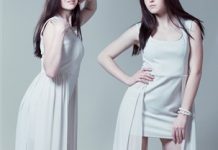
Some chose elaborate gowns split dramatically at the sides so that their stockings and garter belts became part of the visible design. Others wore short skirts, corsets, sheer overlays, or beautifully decorated garter belts paired with high stockings. Several participants deliberately selected outfits that blurred the traditional distinction between underwear and outerwear.
Other women took quieter approaches. One wore a long, traditional-looking dress with only a small glimpse of her stockings visible when she moved. Another chose a beautifully tailored ensemble that looked almost ordinary until she turned and revealed the intricate details hidden at the back. A third participant wore a simple costume because, as she explained afterward, she had discovered that liberation for her meant refusing to dress simply to impress other people.
The audience began to realize that the exhibition was not really about how much clothing a person wore.
It was about choice.
As the evening continued, the participants became increasingly comfortable. The first few women had walked cautiously, watching the audience for signs of approval. Later participants seemed less concerned with the reactions around them. They began experimenting with poses and movements that felt natural to them.
The boldest participants discovered that their courage encouraged others. Women who had initially been nervous began walking more confidently. Some laughed at their own apprehension. Others experimented with poses and movements they would never ordinarily have considered.
Then Elena appeared.
One woman, Elena, embraced an especially bold interpretation. She appeared on the runway wearing a beautifully crafted garter belt and stockings without panties, treating the ensemble as a deliberate statement of confidence and personal freedom. She carried herself with remarkable composure, making it clear that her daring choice was part of her artistic expression rather than something she felt embarrassed about.
Before entering the runway, Elena had admitted that she was nervous. Mira had simply reminded her that she did not have to prove anything to anyone.
“If you are going to do it,” Mira told her, “do it because it means something to you.”
Those words stayed with Elena as she stepped into the lights.
Within seconds, her nervousness disappeared. She walked slowly, confidently, and with an almost playful smile. The audience’s reaction was initially quiet, but it quickly turned into enthusiastic applause.
Elena’s appearance changed something in the room. The audience had now seen that the exhibition was willing to push well beyond ordinary expectations, while Elena herself had demonstrated that boldness did not necessarily mean embarrassment or provocation for its own sake. Her confidence made the artistic purpose of the exhibition clearer.
Another participant, Clara, went even further in a different direction. She wore a dramatic black cape over an otherwise extremely minimal ensemble. At the center of the runway, she removed the cape and revealed her carefully designed costume, prompting surprised laughter and enthusiastic applause from the audience.
Clara had carefully choreographed the moment. She paused after removing the cape, looked toward the audience as though waiting for their verdict, and then gave a theatrical little bow. The laughter that followed was warm rather than mocking. Her theatrical presentation transformed what might otherwise have been a simple fashion display into performance art.
A third participant chose an elaborate outfit covered with ribbons and decorative lace. As she walked, she deliberately paused beneath the brightest spotlight, turning slowly so that the audience could appreciate the craftsmanship of the garment. Her confidence was infectious.
By now, the runway had become a place where each participant seemed to discover something new about herself. Some chose humor. Some chose elegance. Some chose daring. Others remained surprisingly modest. Yet the differences between them only strengthened Mira’s original idea.
Soon, the runway felt less like a fashion show and more like a celebration.
Mira watched proudly from the side of the gallery. She had deliberately avoided imposing rules about what “liberation” should look like. A participant could be modest and still feel liberated. Another could choose an extremely daring presentation and feel equally liberated. The important thing was that the choice belonged to the individual.
She thought that perhaps this was what people often misunderstood about freedom. They assumed that if someone rejected one set of conventions, that person must automatically embrace another. But Mira believed genuine freedom was more complicated. A person could choose tradition, rebellion, simplicity, extravagance, privacy, or openness. The important question was whether the decision was truly one’s own.
Eventually, Mira stepped onto the runway herself.
The music softened, and the room became quiet.
“Liberation,” she told the audience, “is not about everyone looking alike. It is about having the freedom to decide who you want to be.”
The audience applauded.
She continued, “Some of you may think these women are too bold. Others may think they are not bold enough. That is precisely the point. Their choices belong to them.”
That statement brought another wave of applause.
Several participants exchanged smiles. Elena looked toward Clara, and Clara gave her an exaggerated little nod of approval. The nervousness that had been present earlier in the evening seemed completely gone.
By the end of the evening, the exhibition had generated lively conversations throughout the village. Some visitors discussed the artistry of the costumes. Others debated the boundaries between fashion and performance. Many simply admired the participants’ confidence.
Even those who had disliked some of the choices admitted that the exhibition had made them think. That, Mira decided, was success enough. Art did not always have to make everyone agree. Sometimes its purpose was simply to make people reconsider assumptions they had never questioned.
As moonlight spread across the hills and reflected in the sparkling river, The Expression Chamber remained brightly illuminated.
“Liberation” had accomplished something greater than Mira had expected. It had encouraged people to question assumptions, celebrate individuality, and recognize that confidence can take many forms.
For the women who had walked the runway, the boldest part of the evening was not what they wore. It was having the courage to choose it for themselves.