










Before Roanoke: The Spanish Fort Hidden in the North Carolina Mountains
Nearly twenty years before the English attempted to establish their famous Lost Colony at Roanoke, Spanish soldiers built a military settlement beside a thriving Native American town in the foothills of North Carolina. Its name was Fort San Juan. Its neighbors were the people of Joara. Within approximately eighteen months, the Spanish settlement had been destroyed, leaving behind one of the most remarkable and largely forgotten chapters of early American history.
A Town That Existed Long Before the Spanish Arrived
Long before Spanish explorers entered the mountains and valleys of what would become North Carolina, a substantial Native American community flourished along the upper Catawba River watershed.
Its name was Joara.
Located near present-day Morganton in Burke County, Joara was an important settlement in the region. It was not a temporary hunting camp or a small gathering of scattered families. It was an established community with agriculture, trade, leadership, and connections to neighboring Native American populations.
The people who lived there belonged to the broader Mississippian cultural world, a collection of related societies that developed throughout much of the southeastern and central portions of North America.
They cultivated crops, including corn, beans, and squash. They constructed substantial homes and maintained established settlements. Their communities participated in regional trading networks that connected people across considerable distances.
Joara also had a ceremonial and political center. Archaeological investigations have identified an earthen mound associated with the settlement, reflecting traditions found among important Mississippian communities.
Its location was significant. The upper Catawba Valley provided access to fertile land, waterways, and routes leading toward the Appalachian Mountains. These routes connected different communities and facilitated the movement of people and goods.
Joara was therefore more than a convenient place for European explorers to stop. It was an established center of Native American life, with its own leadership, interests, and regional relationships.
The Spanish would soon discover that they had entered a world that was already organized, occupied, and governed.
Spain Looks Toward the Interior
During the sixteenth century, Spain was expanding its colonial possessions throughout the Americas. Spanish explorers and military commanders were searching for territory, wealth, trade opportunities, and routes that might connect distant parts of the Spanish empire.
The southeastern portion of North America was part of this ambition.
In 1565, the Spanish established St. Augustine in present-day Florida. In 1566, they established another settlement, Santa Elena, on what is now Parris Island, South Carolina.
Santa Elena became an important Spanish base for exploration into the interior.
Captain Juan Pardo was assigned to lead an expedition northward and westward. His mission involved extending Spanish influence into the interior, establishing military outposts, and exploring routes that might eventually provide access to Spanish territories and silver resources farther west.
On December 1, 1566, Pardo departed Santa Elena with approximately 125 soldiers.
His men traveled through territory occupied by Native American communities, following established trails and stopping at villages along the way.
The expedition was not moving through an empty wilderness. It was traveling through a populated landscape with established communities, trade routes, and political relationships.
Pardo’s arrival at Joara in January 1567 would bring two very different worlds into direct contact.
The Arrival at Joara
When Pardo reached Joara, he recognized the importance of the settlement.
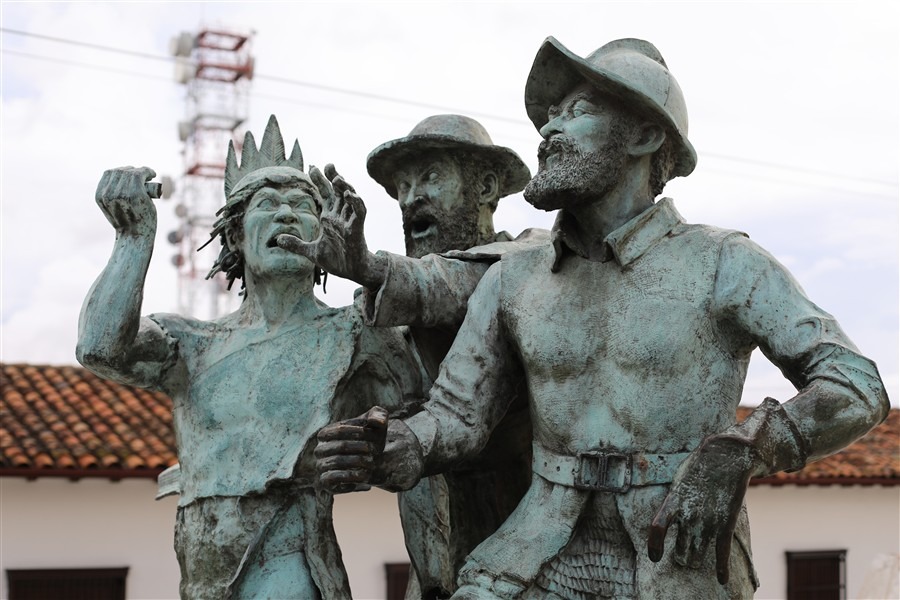
He established a Spanish military outpost beside the Native American town and named it Fort San Juan. He also renamed Joara Cuenca, after his hometown in Spain.
The fort was staffed by approximately thirty Spanish soldiers.
The Spanish had arrived with weapons, military equipment, and manufactured goods that were unfamiliar or valuable to the local population. Iron tools, knives, axes, glass beads, ornaments, and cloth were among the items exchanged during these early encounters.
Initially, the relationship appears to have involved a significant degree of cooperation.
The Spanish needed food and supplies. The people of Joara had the agricultural resources and established community organization necessary to support a settlement of soldiers.
The Native Americans could also benefit from access to European manufactured goods.
Archaeological evidence provides an especially interesting glimpse into this early relationship. Investigations at the Berry Site have revealed that Native American construction practices and materials were incorporated into buildings associated with the Spanish occupation. This suggests that the two populations interacted in practical, everyday ways, not simply through formal diplomatic encounters.
But cooperation did not mean that both sides understood the arrangement in the same way.
Pardo represented the Spanish Crown. He believed that his expedition was extending the authority of the Spanish king into the interior. Spanish accounts describe ceremonies and declarations through which Native American leaders were supposedly accepting Spanish sovereignty.
Whether the people of Joara understood these proceedings as the Spanish intended is another matter entirely.
A Native American leader could agree to trade with strangers, accept gifts, or permit them to establish a nearby residence without believing that he had surrendered control of his community.
This difference in expectations would become increasingly important.
Two Different Ideas of Authority
The Spanish arrived with a political and religious understanding of colonization. They believed that exploration, military occupation, Christian conversion, and recognition of the Spanish monarchy were connected parts of a larger undertaking.
The people of Joara had their own political traditions and regional obligations.
Their leaders were not simply waiting for a European monarch to claim authority over them. They already governed a community with established relationships and interests.
The Spanish could interpret a diplomatic exchange as submission. The Native Americans could understand the same exchange as an agreement between separate groups.
The surviving Spanish documents cannot tell us exactly how every person at Joara interpreted these encounters. That limitation is important. Much of the written history comes from the Europeans themselves, while archaeology provides another perspective.
There was also the practical problem of maintaining a foreign military presence within an established community.
Thirty soldiers required food, shelter, and supplies. Their presence affected the daily lives of the people living nearby. The soldiers brought their own customs, expectations, and demands.
What may have begun as a useful relationship gradually became a more complicated arrangement.
The Spanish were attempting to establish a foothold in territory they did not control. The people of Joara were dealing with visitors whose ambitions extended far beyond ordinary trade.
The Expedition Moves On
Pardo did not remain at Joara continuously.
After establishing Fort San Juan, he left Sergeant Hernando Moyano in command while he returned toward Santa Elena.
Moyano’s time at Joara brought the Spanish into an even more complicated relationship with regional Native American politics.
Spanish accounts describe Moyano becoming involved in military activity alongside Native American warriors. He accompanied warriors from Joara on an expedition against the Chisca, a neighboring people in the Appalachian region.
These events are significant because they show that the Spanish were becoming involved in existing Native American political and military relationships.
Joara had its own alliances and rivalries. Its leaders could use the presence of Spanish soldiers to advance their interests, just as the Spanish hoped to use Native American alliances to advance their colonial ambitions.
The relationship was not simply one of Europeans giving orders and Native Americans following them.
Both groups had objectives. Both attempted to influence the other. And both had reasons to reconsider the arrangement as circumstances changed.
Pardo returned on a second expedition in September 1567. His travels continued through the interior, and his larger ambitions included finding an overland route toward the Spanish mining regions farther west.
But the network of outposts he had established was difficult to maintain.
The Spanish were far from their coastal base. They depended on local communities for provisions and had limited military resources available to defend isolated settlements.
The future of Fort San Juan was becoming uncertain.
The Destruction of Fort San Juan
By 1568, relations between the Spanish and Native American communities had deteriorated.
The conflict was not limited to Joara. Pardo had established a network of six forts during his expeditions, extending Spanish military influence through portions of what are now North Carolina, South Carolina, and eastern Tennessee.
The Spanish outposts were vulnerable. They were separated from one another, far from the coast, and dependent upon relationships with Native American communities.
During 1568, Native American attacks destroyed the Spanish military network.
Fort San Juan was burned. Its Spanish garrison was killed, and the Spanish settlement came to an end.
The evidence indicates that the inhabitants of Joara were directly responsible for the destruction of the Spanish compound. The event is generally understood as a revolt against the Spanish presence, although the precise sequence of events and every contributing grievance cannot be reconstructed with certainty.
The destruction ended Spain’s attempt to maintain this chain of inland military settlements.
The Spanish Crown had hoped to establish a lasting presence in the interior. Instead, the expedition demonstrated how difficult it was to impose colonial authority far from established Spanish bases and without the cooperation of the people who already occupied the land.
The people of Joara and other Native American communities had not simply accepted the permanent presence of foreign soldiers.
They had resisted, and the Spanish military effort collapsed.
The fort that represented Spain’s ambitions in the North Carolina mountains survived for approximately eighteen months.
Four Centuries of Silence
After the destruction of Fort San Juan, its location gradually disappeared from the historical record.
Spanish documents preserved information about Juan Pardo’s expeditions, his travels, and the Native American towns he encountered. But the exact location of the fort remained uncertain.
The town of Joara also faded from written history.
The Native American population of the region experienced profound changes during the centuries that followed. European disease, warfare, displacement, and the continuing expansion of colonial settlement transformed communities throughout the Southeast.
What happened specifically to Joara’s population remains uncertain.
The community may have relocated, joined other settlements, or experienced several generations of changes that cannot now be reconstructed in detail.
The disappearance of Joara from the written record did not mean that its people had never existed. It meant that much of their history had to be recovered through archaeology rather than European accounts.
The physical remains of their settlement remained beneath the soil near Morganton.
The Berry Site: Archaeology Brings the Story Back
For many years, historians and archaeologists searched for physical evidence of the Spanish settlement described in the surviving documents.
Their attention eventually focused on a property known as the Berry Site, located approximately twelve kilometers north of Morganton, near Upper Creek in Burke County.
Archaeological investigations revealed that this was a substantial Native American settlement dating back centuries.
Researchers identified it as the location of Joara.
Excavations uncovered evidence of Native American homes, community features, and the remains of a settlement that had been active during the period of Spanish exploration.
They also discovered European materials associated with the sixteenth-century occupation.
These included Spanish ceramics, iron objects, and other artifacts that connected the site to Juan Pardo’s expedition.
Burned building remains provided additional evidence of the violent end of the Spanish occupation.
In 2006, archaeologists Robin A. Beck Jr., David G. Moore, and Christopher B. Rodning published important research identifying the Berry Site as the location of Joara and Fort San Juan.
In 2013, researchers identified the physical remains of the fort’s defensive structure, adding another important piece of evidence to the archaeological record.
This was a significant breakthrough. For centuries, the location of the fort had remained uncertain despite the survival of Spanish historical accounts.
The Berry Site provided the physical evidence that connected the written record with an actual place.
Researchers have continued to investigate the site, studying its buildings, artifacts, food remains, and other evidence to better understand what life was like during the Spanish occupation.
The archaeological record has made it possible to study aspects of daily life that the Spanish documents barely describe.
It has also reinforced an important historical point: Fort San Juan was built beside an established Native American town, not in an unoccupied wilderness.
What Became of the People of Joara?
The archaeological discovery of Fort San Juan answered one important question. It did not answer all of them.
The fate of Joara’s population remains a subject of historical and archaeological investigation.
The destruction of the fort did not necessarily mean that the entire Native American community was destroyed. The surviving evidence does not establish that conclusion.
Some people may have remained in the area. Others may have moved to neighboring settlements or become part of changing regional communities.
Over time, the arrival of additional European settlers, the spread of disease, warfare, and the loss of traditional territories brought enormous changes to Native American life throughout the Carolinas.
The people who lived at Joara were part of that larger history, but their individual experiences cannot be reconstructed with certainty.
Their story is particularly difficult to recover because most of the surviving written accounts were produced by the Spanish, whose primary concern was documenting their own expeditions.
Archaeology provides another perspective, one grounded in the houses, tools, food remains, and other physical evidence left behind by the people who actually lived there.
There is still much to learn.
A Forgotten Chapter of North Carolina History
Fort San Juan deserves a place in the broader history of early America.
Its establishment preceded the English settlement attempt at Roanoke by approximately twenty years and Jamestown by forty years. It is recognized as the earliest known European settlement in the interior of what is now the United States.
But the significance of Joara extends beyond the question of which European nation arrived first.
The story reminds us that European exploration did not begin in an empty landscape. Long before Spanish or English settlements appeared, Native American communities had developed established societies, political relationships, cultivated fields, substantial towns, and extensive networks of trade.
Joara was one of those communities.
The Spanish arrived believing they could extend the authority of their empire into the interior. They built a fort, stationed soldiers, and attempted to establish a lasting foothold.
But they were operating within a world that already had its own rules and leaders.
The people of Joara were not merely spectators to European expansion. They were participants in the events that shaped their region, and ultimately they helped bring the Spanish military presence to an end.
Today, the Berry Site near Morganton preserves the physical evidence of that encounter.
Beneath its soil are the remains of a Native American community and a short-lived Spanish military settlement. Together, they tell a story that was nearly forgotten for four centuries.
It is a story of ambition, diplomacy, cultural misunderstanding, resistance, and survival.
And it happened right here in North Carolina, long before the familiar story of English America began.
Author’s Notes
This article is based on historical accounts of Juan Pardo’s expeditions and archaeological research conducted at the Berry Site in Burke County, North Carolina.
The narrative distinguishes documented historical events from questions that remain unresolved, particularly concerning the eventual fate of Joara’s inhabitants.
Copyright notice
This article is an original work of historical writing. Its narrative, descriptions, organization, and original commentary are protected by copyright. Historical facts, dates, names, archaeological findings, and events referenced herein remain matters of historical record and are not claimed as exclusive intellectual property. No part of this original article may be reproduced, distributed, or republished without the author’s written permission, except as permitted by law.
References and Further Reading
North Carolina Department of Natural and Cultural Resources: Fort San Juan (N-47).
NCpedia: Fort San Juan.
Beck, Moore, and Rodning: Identifying Fort San Juan: A Sixteenth-Century Spanish Occupation at the Berry Site, North Carolina.
University Press of Florida (2016): Fort San Juan and the Limits of Empire: Colonialism and Household Practice at the Berry Site.
Antiquity Journal: Joara and Fort San Juan: Culture Contact at the Edge of the World.