




















There was a time when her yard was full of life.
For years, a woman made it her habit to feed the birds and squirrels that visited her property. It was not an occasional kindness or something she did only when the weather was pleasant. It was a regular part of her daily routine, repeated so often that it became as natural as tending to the house or preparing a meal.
She scattered corn and pieces of bread across the yard, making sure there was enough for the birds and squirrels that had come to depend on her generosity. She also placed containers of fresh water in several locations. She understood that food was only part of what the animals needed, particularly during the warmer months.
But feeding the wildlife was not her only reason for spending time outside. She enjoyed her flowers, too. She would walk through the yard, tend to her plants, pull weeds, and spend time making things look the way she wanted them.
Over the years, the yard developed a personality of its own.
Birds gathered in the trees and moved freely across the lawn. Squirrels appeared regularly, chasing one another, darting between branches, and investigating whatever food had been left for them. They were playful and plentiful. Occasionally, a snake would make an appearance, and from time to time a deer would wander through.
It was a small, thriving world.
The animals seemed comfortable there. They had become familiar visitors, and the woman had created an environment where they could find food, water, and a relatively undisturbed place to spend their time.
She may have thought of it simply as feeding the wildlife. But through years of repetition, she had become part of their environment, just as the trees, flowers, and shrubs had.
Among all these visitors, however, there was one that seemed particularly interested in her.
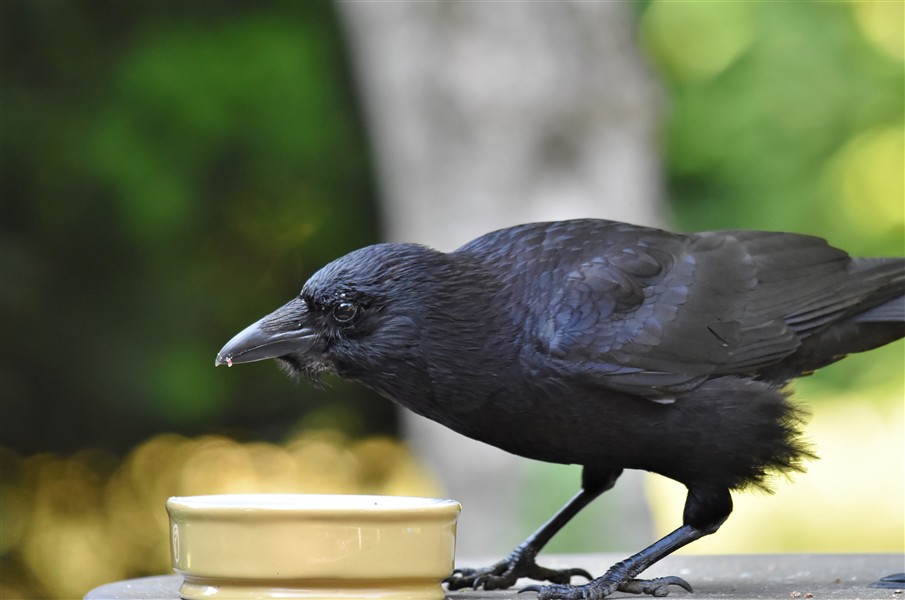
A crow.
Whenever she went into the yard, the crow would appear. It didn’t seem to matter what she was doing. She might be scattering corn and bread for the birds and squirrels, replenishing the water containers, or simply tending to her flowers. Somehow, the crow seemed to know she was there.
Before long, it would begin calling.
She could be working among her flowers, concentrating on a plant that needed attention, and there would be the crow, perched somewhere nearby, making its presence known. It would continue calling as long as she remained outside.
It was almost as if it wanted to talk to her.
The woman, however, did not seem particularly interested in the conversation. In fact, she found the crow irritating. Its persistent calling became an annoyance, especially when she was simply trying to enjoy her time in the yard.
She tried to discourage it.
She made noises to frighten it away and attempted to make herself sufficiently unpleasant that the bird would find somewhere else to spend its time.
Nothing worked.
The crow continued calling. It didn’t seem particularly concerned about her efforts to chase it away. If anything, its persistence made their strange little relationship even more curious.
There was something almost comical about the arrangement. The woman had welcomed an assortment of wildlife into her yard, but this one visitor seemed determined to get her attention, whether she wanted it or not.
Perhaps the crow had learned to recognize her. Perhaps it had associated her presence with food, water, and the familiar activity that took place whenever she entered the yard.
But there was an important distinction. The crow didn’t just appear when food was being distributed. It appeared whenever she was there.
Crows are remarkably intelligent birds. Scientific research has demonstrated that they can recognize individual human faces, remember people who have treated them well or badly, and retain those memories over extended periods. They can learn routines, solve problems, and develop familiar associations with particular people.
Some crows even bring objects to humans with whom they have established a relationship.
Perhaps this particular crow had developed an attachment to the woman. Perhaps it was simply curious about her and had learned that calling produced a response. We cannot know what motivated its behavior.
But to anyone watching, it could easily have appeared that the crow was trying to communicate with her.
She may never have warmed to the bird, but their encounters continued for years. The crow would call, she would try to discourage it, and the bird would carry on as though nothing had happened.
Then, suddenly, the woman was gone.
She passed away, and the daily routine that had continued for years came to an end.
One might reasonably expect the animals to adjust. Wildlife is adaptable. Birds move from one feeding area to another. Squirrels search for alternative sources of food. Deer follow familiar paths until circumstances encourage them to explore elsewhere.
Without someone distributing food and maintaining containers of water, the yard would eventually lose some of its attraction.
That explanation makes sense.
But what happened next was striking.
The birds stopped coming.
The squirrels disappeared.
The occasional visitors were no longer seen wandering through the property. The familiar activity that had once made the yard seem alive gradually vanished.
And the crow?
It has not been heard in the yard since.
That last detail is perhaps the most remarkable.
For years, the crow had appeared whenever the woman went outside. It had called to her while she fed the animals and while she tended her flowers. It had persisted despite her efforts to frighten it away.
Yet after her death, the bird that had seemed so determined to get her attention simply disappeared.
The yard became quiet.
The places where food had once been scattered were no longer gathering points. The containers that had provided water stood without their usual visitors. The flowers and trees remained, and the physical surroundings were largely unchanged.
But the life that had once filled the property was gone.
It is tempting to wonder whether the animals somehow recognized that the woman was no longer there.
Can animals recognize the absence of a familiar human? Can they distinguish between someone who has simply missed a day or two and someone who will never return?
We know that many animals form associations with particular people. Dogs recognize their owners and respond to their absence. Elephants have demonstrated remarkable responses to the remains of other elephants. Crows remember individual humans and can retain those memories for years.
Animals do not necessarily need to understand death in the same way humans do to recognize that something familiar has changed.
A regular source of food has disappeared. A familiar figure no longer walks through the yard. A predictable sequence of events has stopped occurring.
Whether animals experience that change as loss, confusion, or simply a reason to move elsewhere is another question.
And that is where this story becomes interesting.
Perhaps the wildlife abandoned the yard because its dependable source of food and water was gone. Perhaps the crow found another place to spend its time. Nature does not necessarily attach the same meaning to events that human beings do.
Yet the timing leaves room for reflection.
The woman spent years creating a welcoming place for creatures that otherwise would have had little reason to pay particular attention to her. She provided food and water, tended her flowers, and shared her outdoor space with the animals that came to visit.
She may have thought she was simply feeding birds and squirrels.
She may never have considered that, through repetition and familiarity, she had become part of their world.
And perhaps that persistent crow, which seemed so determined to get her attention, had developed a connection of its own. It had learned to recognize her presence and responded in its own unmistakable way.
We cannot know what the animals understood when she stopped appearing. We cannot say that they knew she had died, or that their departure was an expression of mourning.
But we can recognize that relationships between humans and animals are not always as simple as we assume.
Sometimes familiarity develops without words, without affection being openly expressed, and without either participant fully understanding the nature of the relationship.
The woman never seemed particularly fond of the crow. She tried to chase it away, and it refused to cooperate. Yet now, of all the animals that once filled her yard, its absence is perhaps the most noticeable.
The yard has not changed very much.
The trees are still there. The flowers remain. The grass continues to grow. The places where she once scattered food and placed water containers are still part of the landscape.
But the visitors are gone.
And the crow that once seemed so determined to talk to her has not returned.
Perhaps there is an ordinary explanation for everything that happened. There probably is.
Still, one is left with a question.
Did the animals simply lose their reason to visit, or had the woman become such a familiar presence in their lives that her absence changed something beyond the availability of food?
We may never know.
For years, she made room for the wildlife that shared her little corner of the world. She provided for them without expecting anything in return. She may not have realized that she had become a familiar part of their daily existence.
Now that she is gone, the yard has fallen silent.
And the one bird that never seemed to know when to stop talking has nothing more to say.